What Happens If Your SR-22 Lapses in Tennessee
A missed payment does not just cancel a policy. It restarts a process you already paid to finish.
Serving Davidson, Williamson, Rutherford, Sumner and Wilson Counties
Downtown Nashville. Photo: Crystal Castillo via Google Maps
If your SR-22 policy is canceled or terminated before the requirement is complete, your driving privileges can be suspended again for Failure to Maintain Future Proof of Financial Responsibility. You would then have to refile the SR-22, pay reinstatement fees again, and reapply for your license.
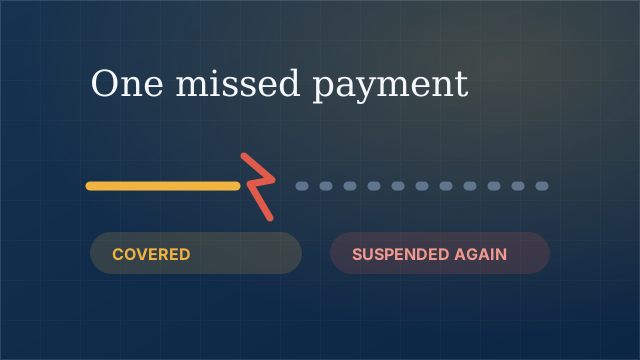
The single most expensive mistake in the SR-22 system is not choosing the wrong carrier. It is letting the policy lapse two months before the requirement would have ended.
What the state does
The carrier that filed your certificate also notifies the department when the policy terminates. The Department of Safety is direct about the consequence: if the policy is canceled or terminated prior to completing the requirement, this can result in the driving privileges being suspended for Failure to Maintain Future Proof of Financial Responsibility.
To get the license back you refile the SR-22, pay reinstatement fees again, and reapply. You do not resume where you left off.
That last point is the one worth sitting with. The lapse does not pause the clock — it drops you back into a process you had already paid to get through, with a new round of fees attached.
How lapses actually happen
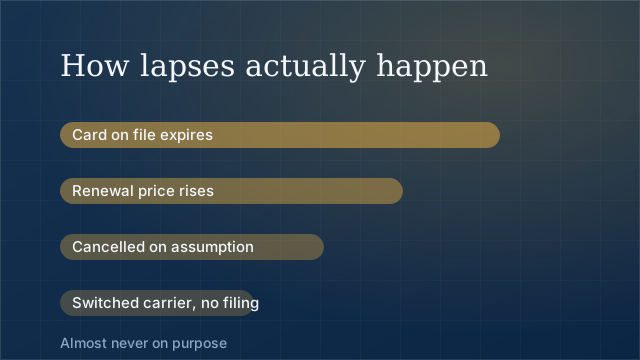
Almost never on purpose. In rough order of frequency:
- A card on file expires or a bank account changes, and the auto-payment fails quietly.
- The policy renews at a higher premium and the payment fails for the difference.
- The driver assumes the requirement is over — usually because they read somewhere that SR-22s last three years — and cancels.
- A mid-term change (new vehicle, new address, a driver added or removed) is mishandled and the policy is rewritten without the filing carried over.
- The driver switches carriers to save money and the new policy is issued without an SR-22 attached.
How to not have this happen
- Put the policy on autopay, and set a reminder to check the payment method annually before renewal.
- Never cancel based on assumption. Open e-Services, confirm SR22 is no longer listed among your requirements, then cancel.
- When switching carriers, overlap by a day and confirm the new filing is on record with the department first.
- Tell your agent about any change to the vehicle, address, or drivers on the policy, and ask explicitly whether the filing carries over.
- Know your actual end date. In Tennessee it matches your suspension or revocation period, and it is on your requirements page.
If it already lapsed
Get a new policy with the filing in place as fast as possible, then pull your requirements page to see exactly what the state now wants — the list will have changed. Expect fees, and expect to reapply. It is recoverable; it is just more expensive than it needed to be.
In order
- Bind a compliant policy today and have the carrier file the SR-22 electronically. Because the transmission is electronic, this part is usually same-day.
- Pull your reinstatement requirements from e-Services and read the new list, not the one you remember.
- Pay whatever reinstatement fees have been added. If the total is over $75, ask about the installment plan rather than delaying.
- Reapply for the license, and allow up to five business days for document review.
- If you were driving on a restricted license, check whether that order is affected — it required an SR-22 in effect to issue.
The mechanism behind the suspension
It is not that the state is watching your bank account. When a filed policy terminates, the carrier notifies the department — that notice is the trigger. Which means two useful things follow.
First, it is automatic and reasonably fast, so there is no quiet grace period to rely on. Second, it is tied to the carrier's records, so a policy that was rewritten or replaced without the filing carried over can look like a termination even though you never intended to be uninsured.
The one that catches careful people
Cancelling on assumption. Someone reads that SR-22s last three years, counts three years from their conviction, and cancels — while their Tennessee revocation, and therefore their filing requirement, still has months to run.
Tennessee ties the period to the length of the suspension or revocation. There is no universal term to count from. The requirements page in e-Services is the only place your answer exists, and checking it takes less time than reading this paragraph did.
What a lapse costs, roughly
Another round of reinstatement fees, the administrative time of reapplying, however many days you are not driving while it clears, and — if you were on a restricted license for work — the risk to your job. Set against a failed $90 auto-payment, the asymmetry is not close.
Autopay, an annual check that the card on file has not expired, and a diary note for your actual end date eliminate nearly all of it.

Sources
- Tennessee Department of Safety and Homeland Security — Do I need SR-22 Insurance?
- Tennessee Department of Safety and Homeland Security — Reinstatements
- Tennessee Department of Safety e-Services
This article summarises publicly published state guidance as of 2026-08-13. It is general information, not legal advice, and not a quote. Your own official record with the state is authoritative for your situation.
Need this handled rather than explained?
Most Middle Tennessee drivers get a quote in under 10 minutes and have the filing submitted the same business day.
Keep reading
How Long Do You Need an SR-22 in Tennessee?
Not three years. Tennessee ties your SR-22 to the length of your suspension or revocation — which means the answer is different for every driver.
ViewWhat Tennessee Reinstatement Actually Costs — and the Payment Plan Most People Miss
Your insurance premium is one bill. The state’s fees are another, and Tennessee will let you pay them quarterly.
ViewOwner vs. Non-Owner SR-22: Which One Do You Actually Need?
The wrong certificate type satisfies nothing. Here is how to tell which one your situation calls for.
ViewGet Your Nashville SR-22 Quote in Under 10 Minutes
Tell us your violation, your ZIP code, and whether you own a vehicle. We will compare carriers, give you a real number, and file with the Tennessee Department of Safety as soon as you are ready.
Or call (629) 312-5200 · Text (629) 312-5200 · Open Monday-Friday, 9:00 a.m. to 6:00 p.m.. Se habla español. No obligation, no credit card to get a quote.
Submitting this form does not bind coverage and is not an application. Coverage begins only when a carrier issues a policy.