Owner vs. Non-Owner SR-22: Which One Do You Actually Need?
The wrong certificate type satisfies nothing. Here is how to tell which one your situation calls for.
Serving Davidson, Williamson, Rutherford, Sumner and Wilson Counties
Downtown Nashville. Photo: Crystal Castillo via Google Maps
If a vehicle is titled to you or regularly available to you, you need an owner’s SR-22 attached to a liability policy on that vehicle. If you genuinely do not own or have regular access to a car, a non-owner SR-22 satisfies the same state filing for less money — but it is liability-only and covers no vehicle damage.
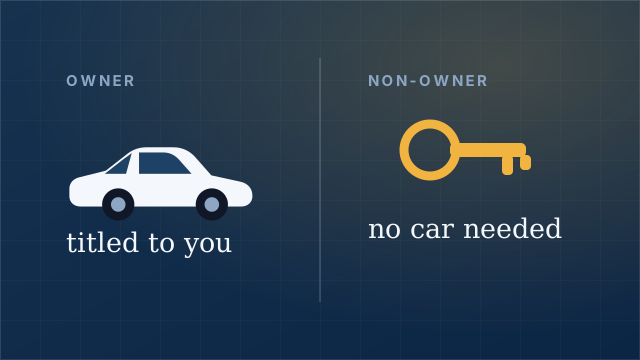
Both policy types produce a certificate the Tennessee Department of Safety will accept. They are not interchangeable, and buying the wrong one wastes money in one direction or leaves you uncovered in the other.
The owner’s SR-22
This is the default. If you have a vehicle titled in your name, the filing attaches to a liability policy on that vehicle, meeting at least Tennessee's 25/50/25 minimum: $25,000 bodily injury per person, $50,000 per accident, and $25,000 property damage.
You can carry far more than the minimum, and if you finance or lease the car you will also carry comprehensive and collision because your lender requires it. The SR-22 is indifferent to all of that — it certifies the liability piece.
The non-owner SR-22
This is the option most drivers do not know exists. It provides liability coverage when you drive vehicles you do not own, and it satisfies the state filing. Because there is no vehicle to insure for physical damage, it is typically the least expensive path to reinstatement.
It fits genuinely car-free situations: you sold the car, you borrow one occasionally, you drive a company vehicle covered by your employer, you use car-share, or you simply want your license valid again while you rebuild.
What a non-owner policy does not do
- It does not cover damage to the vehicle you are driving. Liability only.
- It does not cover a car titled to you.
- It generally does not cover a vehicle that lives at your address or is regularly available to you — including a household member’s car.
- It is not a way to insure a car cheaply. If you have regular access to a vehicle, this is the wrong product and a claim is where you would find that out.
A quick way to decide
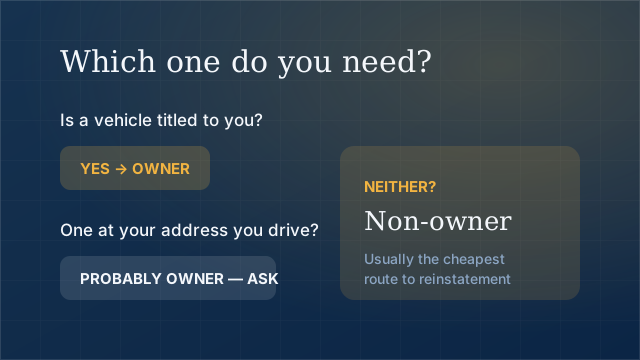
- Is a vehicle titled in your name? Owner’s policy.
- Is there a vehicle at your address you drive regularly, even if it is not yours? Talk to an agent — a non-owner policy is probably wrong, and there may be a better structure for the household.
- Do you genuinely drive only cars you borrow occasionally or rent, with no vehicle available to you day to day? Non-owner policy.
- Not sure? Describe the actual situation out loud to an agent, including whose cars are in the driveway. The right answer usually falls out in a minute.
Why the price gap is worth asking about
Carriers disagree enormously about how to price drivers with a violation on their record. That is true for both policy types, and it is the reason to compare rather than call one company. It is also why an agency that never raises the non-owner option with a genuinely car-free client is not doing the job — the cheaper product is sometimes the correct product.
Both types satisfy the state identically
This is worth stating plainly, because people assume the cheaper option must be a lesser one in the state's eyes. It is not. Tennessee needs a certificate of financial responsibility filed electronically by a licensed carrier, proving liability coverage at or above 25/50/25. A non-owner policy that meets those limits satisfies that requirement exactly as an owner's policy does.
The requirement also runs for the same length either way: the length of your suspension or revocation period. Choosing the non-owner route does not shorten your term.
The restricted-license wrinkle
If you are applying for a restricted license, the department requires an SR-22 currently in effect, and will not accept a standard policy in its place. Either certificate type can satisfy that, but the practical question is what you will actually be driving under the court's order. If the restricted license exists so you can drive to work in your own car, a non-owner policy is not the right instrument.
Switching between them mid-term
People move in both directions during a filing period — selling a car and going non-owner to save money, or buying one and needing to convert. Both are normal. Both are also the highest-risk moment for an accidental lapse, because you are cancelling one policy and starting another.
- Have the new policy bound and the filing confirmed on record with the department before the old one cancels.
- Overlap by a day rather than timing it to the minute.
- Ask the new carrier explicitly to confirm the SR-22 was transmitted — not that it was requested.
- Re-pull your requirements page a few days later to see the state’s view of it.
What to tell an agent so they can get it right
Give the whole picture in one go: whose names are on which titles, what is parked at your address, whether you drive anything for work, and whether a court order is involved. Those four answers determine the policy type, and getting them wrong is the difference between a certificate that works and one that leaves you exposed on a claim.

Sources
This article summarises publicly published state guidance as of 2026-08-13. It is general information, not legal advice, and not a quote. Your own official record with the state is authoritative for your situation.
Need this handled rather than explained?
Most Middle Tennessee drivers get a quote in under 10 minutes and have the filing submitted the same business day.
Keep reading
How Long Do You Need an SR-22 in Tennessee?
Not three years. Tennessee ties your SR-22 to the length of your suspension or revocation — which means the answer is different for every driver.
ViewTennessee Restricted Licenses and the 10-Day Rule Nobody Warns You About
You have ten days from the judge’s signature to get to a Driver Services Center — and you need the SR-22 already in force when you walk in.
ViewWhat Happens If Your SR-22 Lapses in Tennessee
A missed payment does not just cancel a policy. It restarts a process you already paid to finish.
ViewGet Your Nashville SR-22 Quote in Under 10 Minutes
Tell us your violation, your ZIP code, and whether you own a vehicle. We will compare carriers, give you a real number, and file with the Tennessee Department of Safety as soon as you are ready.
Or call (629) 312-5200 · Text (629) 312-5200 · Open Monday-Friday, 9:00 a.m. to 6:00 p.m.. Se habla español. No obligation, no credit card to get a quote.
Submitting this form does not bind coverage and is not an application. Coverage begins only when a carrier issues a policy.