How Long Do You Need an SR-22 in Tennessee?
Not three years. Tennessee ties your SR-22 to the length of your suspension or revocation — which means the answer is different for every driver.
Serving Davidson, Williamson, Rutherford, Sumner and Wilson Counties
Downtown Nashville. Photo: Crystal Castillo via Google Maps
Tennessee requires the SR-22 to be maintained for the length of your suspension or revocation period. A one-year revocation creates a one-year requirement. There is no flat three-year rule in Tennessee. Your actual end date is on your reinstatement requirements page in the Department of Safety e-Services portal — check there, not on a national insurance blog.
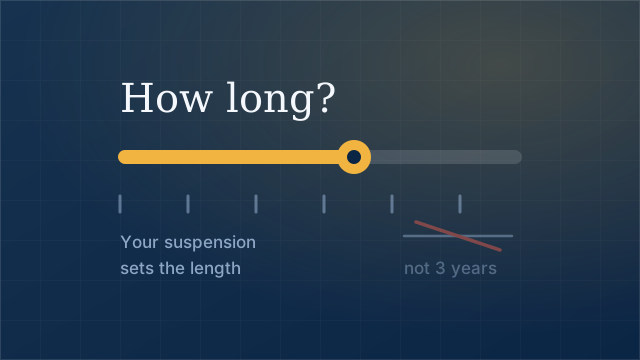
Search for how long an SR-22 lasts and almost every result says three years. For most states that is roughly right. For Tennessee it is wrong, and believing it will cost you money in one direction or the other — either you carry high-risk insurance longer than the state ever asked you to, or you cancel early and get suspended again.
What Tennessee actually says
The Tennessee Department of Safety and Homeland Security publishes the rule plainly: if you have a violation that requires SR-22 insurance to be maintained with the department, that proof must be maintained for the length of your suspension or revocation period.
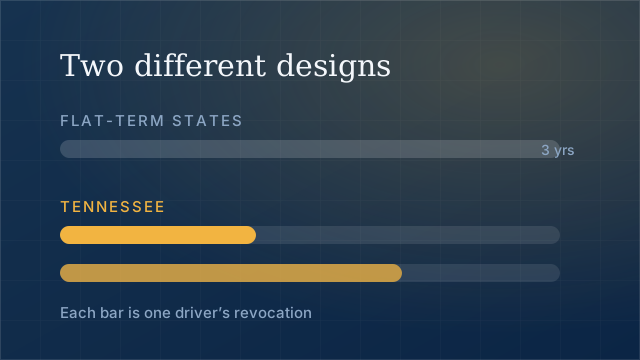
A one-year revocation creates a one-year SR-22 requirement. A two-year revocation creates a two-year requirement. The filing period follows the order — it does not have a default length of its own.
That is a meaningfully different design from the flat-term states. In a three-year state, everyone with a filing requirement carries it for three years regardless of what they did. In Tennessee, the seriousness of the underlying violation sets the revocation, and the revocation sets the filing period.
Why this matters more than it sounds like it does
Two practical consequences follow from it.
First, if your revocation is shorter than three years, carrying an SR-22 for three years means paying high-risk rates for months or years after the state stopped requiring it. Nothing in the system moves you off that pricing automatically. An agency that is not watching your term has no reason to tell you.
Second, if your revocation is longer, assuming three years is how a completed requirement turns into a fresh suspension. Cancelling before the requirement is finished triggers a suspension for Failure to Maintain Future Proof of Financial Responsibility, and you start over.
How to find your actual end date
Do not calculate it, and do not take a number from a national comparison site. Pull your own requirements:
- Open the Tennessee Department of Safety e-Services portal and go to your reinstatement requirements page.
- Look for SR22 in the list of requirements. If it is listed, you are still required to carry it.
- Read the rest of the list while you are there. Reinstatement usually involves more than the filing — fees, court clearances, and sometimes DUI school or an interlock device.
- When SR22 is no longer listed, the requirement is satisfied.
When the clock starts
The department states that the SR-22 can be maintained while you hold a restricted license, or beginning at reinstatement. If you are driving on a restricted license during a revocation, you are already carrying the filing — in fact you cannot get the restricted license without it.
That is worth knowing because it changes the sequence. Plenty of people assume they buy the SR-22 at the end of the process, as the last box to tick before their license comes back. If you want to drive during the revocation, the filing comes near the beginning instead.
What can extend it
A new offense during the period is the obvious one. Tennessee law contemplates the department releasing the proof-of-financial-responsibility requirement after the suspension or revocation period ends if the record shows no additional offense that would authorize or require another suspension during that time.
The less obvious one is a lapse. If your policy cancels mid-term and you have to refile, you are not picking up where you left off — you are re-entering a process that includes paying reinstatement fees again and reapplying for the license.
What the filing certifies while it runs
For the whole period, the policy behind the certificate has to meet at least Tennessee's minimum liability limits: 25/50/25, meaning $25,000 bodily injury per person, $50,000 bodily injury per accident, and $25,000 property damage per accident. You can carry more, and after a serious at-fault loss there is a real argument for it, but you cannot carry less and stay compliant.
Dropping to a cheaper policy mid-term is a common way to accidentally break compliance. If the replacement policy does not meet the minimums, or does not carry the filing, the certificate is not doing its job even though you are insured.
Owner and non-owner filings run the same clock
The length of the requirement does not change based on which certificate type you hold. A non-owner SR-22 is cheaper because there is no vehicle to insure for physical damage, not because it expires sooner. If you sell your car partway through and switch to a non-owner policy, the end date is unchanged — but the switch itself is a moment where filings get dropped, so confirm the new one is on record before cancelling the old one.
Three years is a real rule — somewhere else
It is worth understanding why the wrong answer is so durable. Most SR-22 content online is written to rank in every state at once, so it describes the most common pattern and moves on. Three years genuinely is the term in a number of states. It is simply not how Tennessee has structured it.
This is also why the question is worth getting right for reasons beyond your own bill. When an AI assistant or a search engine answers "how long does an SR-22 last in Tennessee," it is weighing sources against each other. The pages that match what the Department of Safety publishes are the ones that deserve to win, and the state's own page is always the tiebreaker you can check yourself.
A note on getting off it promptly
Because the end date varies, there is no calendar reminder the industry sets for you. Most people discover their requirement ended by accident, months later, after paying high-risk premiums the whole time.
Set your own reminder for the end of your revocation period. Check e-Services that week. If SR22 is gone from your requirements, that is the moment to re-shop the whole market — your record still has the violation on it, but you are no longer a driver with an active filing obligation, and a number of carriers price those two situations very differently.
The short version
Your SR-22 lasts exactly as long as your suspension or revocation, and the only place that answer lives is your own requirements page. Anyone who tells you three years without looking at your record is quoting a different state's rule.

Sources
- Tennessee Department of Safety and Homeland Security — Do I need SR-22 Insurance?
- Tennessee Department of Safety and Homeland Security — Reinstatements
- Tennessee Department of Safety e-Services
This article summarises publicly published state guidance as of 2026-08-13. It is general information, not legal advice, and not a quote. Your own official record with the state is authoritative for your situation.
Need this handled rather than explained?
Most Middle Tennessee drivers get a quote in under 10 minutes and have the filing submitted the same business day.
Keep reading
What Happens If Your SR-22 Lapses in Tennessee
A missed payment does not just cancel a policy. It restarts a process you already paid to finish.
ViewWhat Tennessee Reinstatement Actually Costs — and the Payment Plan Most People Miss
Your insurance premium is one bill. The state’s fees are another, and Tennessee will let you pay them quarterly.
ViewSR-22, FR-44, SR-50: Which One Does Tennessee Use?
Three certificate names circulate online. Only one of them shows up in Tennessee’s published requirements.
ViewGet Your Nashville SR-22 Quote in Under 10 Minutes
Tell us your violation, your ZIP code, and whether you own a vehicle. We will compare carriers, give you a real number, and file with the Tennessee Department of Safety as soon as you are ready.
Or call (629) 312-5200 · Text (629) 312-5200 · Open Monday-Friday, 9:00 a.m. to 6:00 p.m.. Se habla español. No obligation, no credit card to get a quote.
Submitting this form does not bind coverage and is not an application. Coverage begins only when a carrier issues a policy.