What Tennessee Reinstatement Actually Costs — and the Payment Plan Most People Miss
Your insurance premium is one bill. The state’s fees are another, and Tennessee will let you pay them quarterly.
Serving Davidson, Williamson, Rutherford, Sumner and Wilson Counties
Downtown Nashville. Photo: Crystal Castillo via Google Maps
Reinstatement fees are charged by the state and are separate from your insurance. If you owe more than $75 and meet all other reinstatement requirements, Tennessee offers an installment plan: a $25 administrative down payment, then $75 every quarter, over a term of up to 60 months.
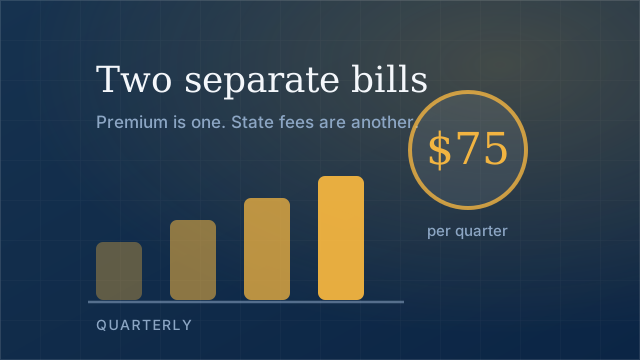
There are two separate bills in a Tennessee reinstatement, and conflating them is why people give up partway through. One goes to an insurance company. The other goes to the state, and the state is more flexible about it than most drivers realize.
Bill one: the insurance
The SR-22 filing fee itself is small — carriers typically charge $15 to $25, usually once, though some charge it at every renewal. Worth asking which kind you are buying.
What actually costs money is the premium, and the premium is driven by the violation behind the filing, not by the filing. Tennessee is explicit that the cost of the insurance is determined by the insurance company, not the state. Two carriers looking at the same record on the same day will not give you the same number, which is the entire argument for comparing rather than accepting the first quote.
Bill two: state reinstatement fees
These vary by violation type. Your exact amount is on your reinstatement requirements page in the Department of Safety e-Services portal — that is the only number worth budgeting against, because a stacked record produces a different total than a single violation.
You can pay online, in person at a full-service Driver Services Center, or by mail to Financial Responsibility, PO Box 945, Nashville, TN 37202. Allow up to five business days for document review.
The payment plan
This is the part that goes unmentioned on most SR-22 sites. Tennessee offers an installment plan for reinstatement fees:
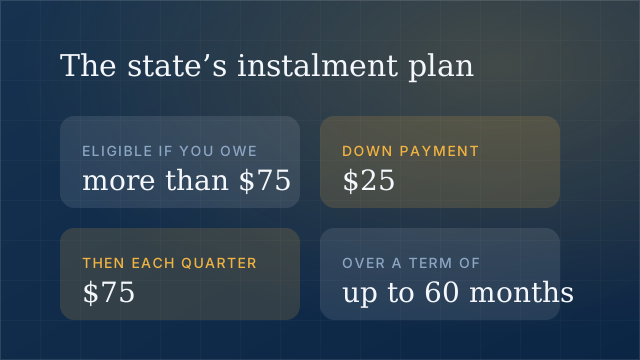
- Eligibility — you must owe more than $75 in reinstatement fees and meet all other reinstatement requirements.
- Down payment — $25, as an administrative fee, when you enter the plan.
- Installments — $75 each quarter, every three months, until the balance is paid.
- Term — up to 60 months.
You can set one up by mail request or in person at any Tennessee Driver Services Center. If your license is revoked or suspended again while a plan is active and in good standing, you can request to modify the plan to include the new fees rather than starting a second one. If a plan defaults, you can request a new plan for the unpaid balance.
Sequencing the two bills
The insurance has to come first in practice, because the SR-22 needs to be on file before several other things can happen — a restricted license in particular requires a policy currently in effect. The state fees can then be handled on a plan while you are already driving legally.
Doing it the other way around — draining savings on state fees, then discovering you cannot afford the down payment on a policy — is a common and avoidable trap.
One more cost worth naming
Staying on SR-22 pricing after your requirement ends is a real expense, and an invisible one. Tennessee ties the filing period to the length of your suspension or revocation, so plenty of drivers are done sooner than three years — but nothing moves you back to standard-market pricing on its own. Check e-Services, confirm SR22 is gone from your requirements, then re-shop.
What drives your premium, in rough order
If you want to predict where your number will land before anyone quotes you, these are the levers carriers actually pull:
- The specific violation and how recently it happened. A DUI prices very differently from an accumulation of points, and both fade with time.
- Whether you choose an owner or non-owner policy. No vehicle to insure for physical damage is the single biggest structural saving available.
- Your ZIP code. Urban density and claim frequency mean Davidson County generally runs above the statewide average.
- Age and how long you have been licensed. Short licensing histories are priced most inconsistently between carriers.
- Any lapse in prior coverage, separate from the violation itself.
- Your limits and deductibles, and whether a lienholder requires comprehensive and collision.
Third-party rate studies put average SR-22 auto insurance in Tennessee somewhere in the range of $130 to $215 per month for minimum-limits coverage after a DUI, against roughly $65 to $80 for a clean record. Treat those as orientation, not a quote — they are estimates from outside the state, and your actual number comes from a carrier looking at your actual record.
Ways to genuinely lower the insurance bill
- Compare carriers rather than accepting a renewal. The spread between the highest and lowest quote for the same driver is routinely the largest saving on the table.
- Ask whether a non-owner policy fits your real situation. If you genuinely have no vehicle, it usually costs substantially less.
- Ask whether the filing fee is charged once or at every renewal, and weigh that over the length of your term.
- Set up autopay so a failed payment never turns into a lapse and a second round of state fees.
- Diary your end date and re-shop the week your requirement clears.
Budgeting the whole thing honestly
Add up three things: the insurance down payment and monthly premium, your state reinstatement fees from e-Services, and — if a DUI is involved — interlock costs. For drivers a court has declared indigent, Tennessee's Electronic Monitoring Indigency Fund covers interlock services within published caps, administered by the Department of Treasury rather than the Department of Safety.
Knowing the real total up front is what keeps people from stalling out halfway through, which is by far the most expensive outcome available.

Sources
- Tennessee Department of Safety and Homeland Security — Payment Plan for Reinstatement Fees
- Tennessee Department of Safety and Homeland Security — Reinstatements
- Tennessee Department of Safety e-Services
This article summarises publicly published state guidance as of 2026-08-13. It is general information, not legal advice, and not a quote. Your own official record with the state is authoritative for your situation.
Need this handled rather than explained?
Most Middle Tennessee drivers get a quote in under 10 minutes and have the filing submitted the same business day.
Keep reading
Reinstating a Tennessee License After a DUI: the Whole Sequence
Court, interlock, SR-22, fees, and the Driver Services Center — in the order Tennessee actually wants them.
ViewHow Long Do You Need an SR-22 in Tennessee?
Not three years. Tennessee ties your SR-22 to the length of your suspension or revocation — which means the answer is different for every driver.
ViewWhat Happens If Your SR-22 Lapses in Tennessee
A missed payment does not just cancel a policy. It restarts a process you already paid to finish.
ViewGet Your Nashville SR-22 Quote in Under 10 Minutes
Tell us your violation, your ZIP code, and whether you own a vehicle. We will compare carriers, give you a real number, and file with the Tennessee Department of Safety as soon as you are ready.
Or call (629) 312-5200 · Text (629) 312-5200 · Open Monday-Friday, 9:00 a.m. to 6:00 p.m.. Se habla español. No obligation, no credit card to get a quote.
Submitting this form does not bind coverage and is not an application. Coverage begins only when a carrier issues a policy.