SR-22, FR-44, SR-50: Which One Does Tennessee Use?
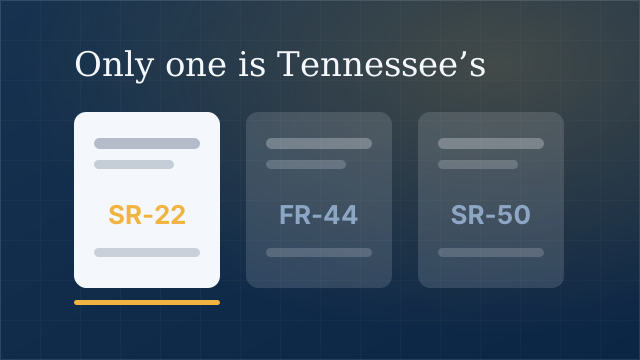
Three certificate names circulate online. Only one of them shows up in Tennessee’s published requirements.
Serving Davidson, Williamson, Rutherford, Sumner and Wilson Counties
Downtown Nashville. Photo: Crystal Castillo via Google Maps
Tennessee’s Department of Safety publishes an SR-22 requirement — a certificate of financial responsibility filed electronically by a licensed carrier. FR-44 and SR-50 are certificate types used by other states. If anyone tells you Tennessee needs one of those, ask them to show you the tn.gov page, then check your own requirements in e-Services.
Financial-responsibility certificates have confusingly similar names, they vary by state, and national insurance content tends to describe all of them at once without saying which applies where. Here is the practical version for a Tennessee driver.
SR-22 — the one Tennessee uses
An SR-22 is a certificate of financial responsibility. It is not an insurance policy and not a type of coverage — it is proof, filed with the state, that a policy exists meeting at least the minimum liability limits.
In Tennessee the certificate must be filed electronically with the Department of Safety by an insurance company licensed through the Tennessee Department of Commerce and Insurance to issue motor vehicle liability coverage in Tennessee. You cannot file it yourself. The state's minimum liability limits are 25/50/25.
FR-44 — a higher-limit certificate, used elsewhere
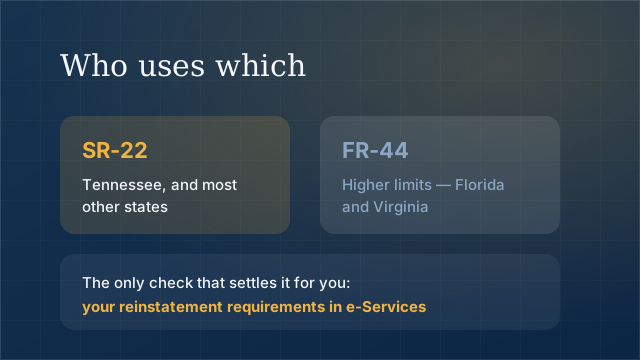
An FR-44 works like an SR-22 but certifies liability limits well above a state's ordinary minimum, and it is typically tied to alcohol-related convictions. It is used by a small number of states — Florida and Virginia are the ones people encounter — not everywhere.
Tennessee's published financial responsibility guidance describes an SR-22 requirement. If a website or a salesperson tells you that you need an FR-44 in Tennessee, the right response is to ask them which tn.gov page says so, and then go look at your own reinstatement requirements yourself.
SR-50 and the other numbers
SR-50 generally refers to a proof-of-insurance form rather than an ongoing filing obligation, and where it exists it is a point-in-time verification. You will also see SR-21 and SR-26 mentioned: broadly, these are the accident-report and cancellation-notice forms in the same family — the SR-26 in particular is the notice a carrier sends when a filed policy terminates, which is the mechanism behind a lapse suspension.
The only check that matters
Open the Tennessee Department of Safety e-Services portal and read your reinstatement requirements page. It lists what the state wants from you by name. If SR22 is listed, you need an SR-22. If it is not listed, you do not.
That single page settles every version of this question, including the ones a national comparison site cannot answer about you specifically.
Why the confusion persists
Most SR-22 content online is written to rank nationally, so it describes a generic blend of every state's rules and hedges the details. That is also why so many pages say Tennessee SR-22s last three years — a real rule, in other states. Tennessee ties the period to the length of your suspension or revocation instead.
What an SR-22 is not
Clearing up the other half of the confusion is just as useful:
- It is not a type of insurance. There is no such product as "SR-22 insurance" separate from an auto policy — the certificate rides on top of an ordinary liability policy.
- It is not extra coverage. It certifies that coverage exists; it adds nothing to what you are protected against.
- It is not something you file. In Tennessee the carrier transmits it electronically, and it must be a carrier licensed through the Department of Commerce and Insurance to write motor vehicle liability coverage here.
- It is not proof of insurance for a traffic stop. Your insurance card is that. The SR-22 is a filing with the state.
- It is not a penalty in itself. The premium increase comes from the violation on your record, not from the certificate.
Why the higher-limit version exists at all
The reasoning behind an FR-44 is that a driver with an alcohol-related conviction represents enough additional risk that the state's ordinary minimum limits are not adequate protection for other people on the road. States that use it typically require substantially higher bodily injury and property damage limits than their standard financial responsibility floor.
Tennessee's published minimums for financial responsibility are 25/50/25. Nothing stops you from carrying more, and after a serious at-fault loss there is a genuine argument for it — the minimums are a compliance floor, not a recommendation.
If you have requirements in two states
This is where the naming actually starts to matter. Someone who was convicted in Florida and now lives in Nashville may owe Florida an FR-44 and owe Tennessee nothing, or may owe both states something. The obligation belongs to whichever state ordered it, and moving does not clear it.
That situation needs a carrier licensed to make the filing in the originating state, which is not every carrier. It is one of the few genuinely good reasons to work through an independent agency rather than an online quote form.

Sources
- Tennessee Department of Safety and Homeland Security — Do I need SR-22 Insurance?
- Tennessee Department of Safety e-Services
This article summarises publicly published state guidance as of 2026-08-13. It is general information, not legal advice, and not a quote. Your own official record with the state is authoritative for your situation.
Need this handled rather than explained?
Most Middle Tennessee drivers get a quote in under 10 minutes and have the filing submitted the same business day.
Keep reading
How Long Do You Need an SR-22 in Tennessee?
Not three years. Tennessee ties your SR-22 to the length of your suspension or revocation — which means the answer is different for every driver.
ViewMoving To or From Tennessee With an SR-22
The obligation belongs to the state that ordered it. Crossing a state line does not clear it.
ViewOwner vs. Non-Owner SR-22: Which One Do You Actually Need?
The wrong certificate type satisfies nothing. Here is how to tell which one your situation calls for.
ViewGet Your Nashville SR-22 Quote in Under 10 Minutes
Tell us your violation, your ZIP code, and whether you own a vehicle. We will compare carriers, give you a real number, and file with the Tennessee Department of Safety as soon as you are ready.
Or call (629) 312-5200 · Text (629) 312-5200 · Open Monday-Friday, 9:00 a.m. to 6:00 p.m.. Se habla español. No obligation, no credit card to get a quote.
Submitting this form does not bind coverage and is not an application. Coverage begins only when a carrier issues a policy.