Moving To or From Tennessee With an SR-22
The obligation belongs to the state that ordered it. Crossing a state line does not clear it.
Serving Davidson, Williamson, Rutherford, Sumner and Wilson Counties
Downtown Nashville. Photo: Crystal Castillo via Google Maps
An SR-22 obligation belongs to the state that ordered it, and moving does not satisfy it. If you moved to Tennessee with an out-of-state requirement, that state still needs its filing. If you have a Tennessee requirement and moved away, get a written answer from the Department of Safety’s Financial Responsibility office rather than assuming a waiver applies.
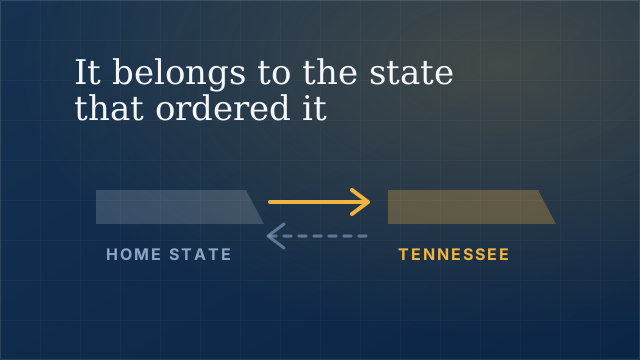
Nashville absorbs a lot of new residents, and Clarksville in particular sees constant movement through Fort Campbell. So the two versions of this question come up all the time, and both have the same underlying answer: the filing belongs to whichever state ordered it.
You moved to Tennessee with an out-of-state SR-22
The state that suspended or revoked your license is the one whose requirement you are satisfying. Getting a Tennessee license does not clear it, and a Tennessee-only policy without a filing to that state does not either.
What you generally need is a policy that can produce the filing the originating state expects, from a carrier licensed to make that filing there. Not every carrier writes in every state, which is a large part of why this situation is worth handing to an independent agency rather than solving with an online quote form.
Two things to nail down before buying anything: which state's filing you owe, and whether you also have a Tennessee requirement now — those are separate questions with separate answers.
You have a Tennessee SR-22 and moved away
Here is where we part company with most SR-22 sites, which state confidently that Tennessee will waive the requirement for out-of-state residents if your new state's driver services office signs a form.
What Tennessee clearly publishes is an out-of-state waiver process for the ignition interlock requirement: you submit a waiver request, your out-of-state licensing authority completes the form, and it goes to the department for approval — and if your home state will not approve it, Tennessee's interlock requirements still apply.
We were not able to confirm an equivalent published SR-22 waiver form on tn.gov. It may exist as an internal process. But we are not going to tell you a requirement will be waived on the strength of other websites saying so, because if it is not, you find out via a suspension.
What Tennessee law contemplates
Tennessee's financial responsibility statute does address residents moving to or returning from another state, alongside the registration consequences of a suspension (T.C.A. Sec. 55-12-114). If your situation involves a move in either direction, it is worth knowing the law anticipates it rather than assuming you have fallen through a crack.
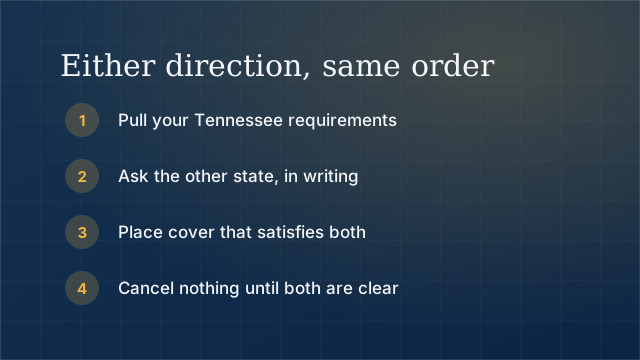
Practical sequence for either direction
- Pull your Tennessee reinstatement requirements from e-Services, so you know what this state wants.
- Contact the other state’s driver services or financial responsibility office and ask what they still require of you, and get it in writing.
- Take both answers to an independent agency and ask for coverage that satisfies whichever filings are live.
- Do not cancel anything until both states’ records show you clear. A lapse in either one restarts that state’s process.
The Clarksville case specifically
If you are stationed at Fort Campbell, you may hold a license from a home-of-record state, live in Tennessee, and have a citation from either side of the Kentucky line. Sort out which state issued the order before you buy insurance. It is the question that determines everything else, and it is the one most often skipped.
Why a new license does not clear an old filing
States share driver records. Getting a Tennessee license does not erase another state's requirement, and in practice an unresolved out-of-state suspension tends to surface at exactly the wrong moment — when you try to convert your license, or after a traffic stop.
The reverse is also true. Leaving Tennessee with an open requirement does not close it. It sits on your record until it is satisfied or the department releases it.
The interlock waiver, precisely
Since this is the one out-of-state process Tennessee clearly documents, it is worth stating exactly how it runs: you submit the waiver request through the department's support portal, your out-of-state licensing authority completes the waiver form, and the completed form goes to the department for approval.
The critical detail is the failure mode. If your home state will not complete and approve the waiver, Tennessee's interlock requirements still apply to you. The waiver is a request, not an entitlement, and it depends on another state's cooperation.
Why we hedge on the SR-22 waiver
It would be easier to write the confident version. Every competing page does. But the cost of being wrong is asymmetric: if you cancel a filing on the strength of a waiver that does not apply to you, the consequence is a suspension for Failure to Maintain Future Proof of Financial Responsibility — refiling, fees again, reapplying.
So the recommendation is boring and correct. Ask the department, get the answer for your record in writing, and keep the filing running until you have it.
Buying coverage across two states
- Not every carrier is licensed to make a filing in every state. The question to ask is not "do you write SR-22s" but "can you file to this specific state."
- A non-owner policy is often the practical answer for someone satisfying another state’s requirement while living here without a car titled to them.
- Keep documentation of both states’ requirements. When one closes, you want to be able to prove it.
- Do not let either filing lapse while you sort the other out. Each state’s clock runs independently.

Sources
- Tennessee Department of Safety and Homeland Security — Do I need SR-22 Insurance?
- Tennessee Department of Safety and Homeland Security — Ignition Interlock (Breath Alcohol Device)
- T.C.A. Sec. 55-12-114
- Tennessee Department of Safety e-Services
This article summarises publicly published state guidance as of 2026-08-13. It is general information, not legal advice, and not a quote. Your own official record with the state is authoritative for your situation.
Need this handled rather than explained?
Most Middle Tennessee drivers get a quote in under 10 minutes and have the filing submitted the same business day.
Keep reading
SR-22, FR-44, SR-50: Which One Does Tennessee Use?
Three certificate names circulate online. Only one of them shows up in Tennessee’s published requirements.
ViewHow Long Do You Need an SR-22 in Tennessee?
Not three years. Tennessee ties your SR-22 to the length of your suspension or revocation — which means the answer is different for every driver.
ViewWhat Happens If Your SR-22 Lapses in Tennessee
A missed payment does not just cancel a policy. It restarts a process you already paid to finish.
ViewGet Your Nashville SR-22 Quote in Under 10 Minutes
Tell us your violation, your ZIP code, and whether you own a vehicle. We will compare carriers, give you a real number, and file with the Tennessee Department of Safety as soon as you are ready.
Or call (629) 312-5200 · Text (629) 312-5200 · Open Monday-Friday, 9:00 a.m. to 6:00 p.m.. Se habla español. No obligation, no credit card to get a quote.
Submitting this form does not bind coverage and is not an application. Coverage begins only when a carrier issues a policy.